Kawagoe Hikawa Shrine
川越氷川神社
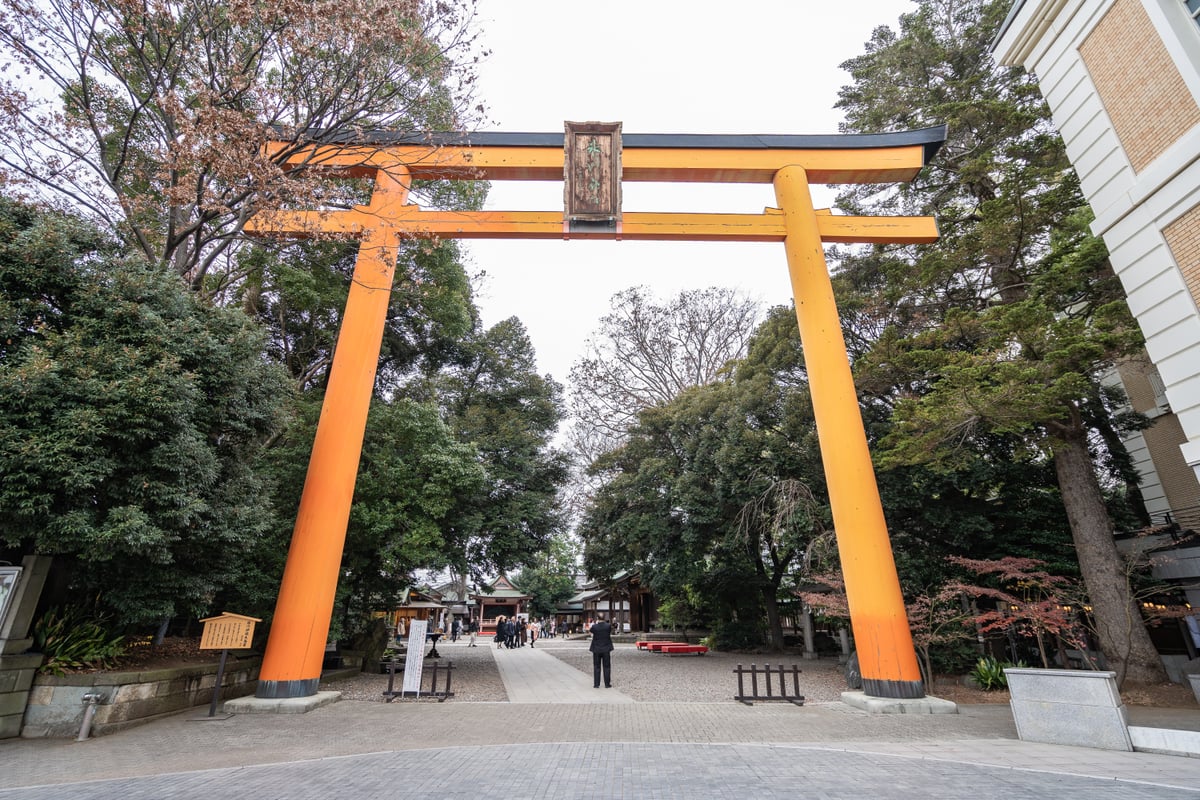
A shrine beloved as the guardian deity of all Kawagoe, known for match-making blessings. Its five enshrined deities are led by the divine couple Susanoo-no-Mikoto and Kushinadahime-no-Mikoto, and the shrine is known for blessings of family harmony and good relationships. Within the grounds stands the towering 'Meoto Kusu' (married camphor trees), a symbol of marital harmony, and it is said that walking around its base grants wishes. Each morning, a limited number of 'Enmusubi Tama' (matchmaking charms) are distributed on a first-come, first-served basis; floating one in water to reveal its pattern is said to make a wish come true, and because supplies are limited, long lines form from early morning. In summer, about 2,000 Edo furin (wind chimes) decorate the grounds during the 'Enmusubi Furin' event, creating a fantastical scene with a tunnel of wind chimes and lights reflected in a small stream. The shrine's annual festival is said to be the origin of Kawagoe's signature event, the Kawagoe Matsuri, in which gorgeously decorated floats parade through the city in October. Visited by people of all generations seeking everything from romantic success to family harmony, it is one of Kawagoe's foremost power spots.
Highlights
The grounds feature an 'Ema Tunnel' lined with votive plaques wishing for good relationships, popular as a photogenic spot. The 'Enmusubi Tama' charms, limited to 1,500 per day, are distributed from 8:00 am, one per person; floating it in the stream on the grounds and having your own unique pattern appear is said to grant your wish. From late June to early September each year, the 'Enmusubi Furin' event is held, filling the grounds with about 2,000 Edo wind chimes; from evening the illuminated wind-chime corridor and 'River of Light' create a fantastical atmosphere.
History
The shrine's founding dates back to ancient times, said to have been established in the second year of Emperor Kinmei's reign (541 CE). During the Edo period it was deeply revered by successive lords of the Kawagoe domain and developed as the guardian shrine of all Kawagoe. Kawagoe's signature festival, the Kawagoe Matsuri, is said to have begun when Matsudaira Nobutsuna, lord of the Kawagoe domain, donated a full set of festival equipment to Hikawa Shrine in 1648 (Keian 1); the shrine's annual festival became the origin of the event.

![[New Trip] スーツケース キャリーケース 拡張機能付き 機内持ち込み 軽量 大型 キャリーバック Sサイズ 40L 2~3泊 アイボリー | 旅行や出張で荷物が増えても安心!マチ幅5cm拡張で容量約20%アップ。耐衝撃ボディ、信頼のYKKファスナー、海外旅行に欠かせないTSAロック、静音ダブルキャスター、多段階調節キャリーバー搭載、S/M/Lの3サイズ展開。](https://m.media-amazon.com/images/I/61mh9ATG7UL._AC_SL1500_.jpg)

Seasonal Highlights
🌿 Summer (Jun-Aug)
During the Enmusubi Furin period from late June to early September, the shrine is illuminated after sunset for a fantastical atmosphere.
🍁 Autumn (Sep-Nov)
In October, the Kawagoe Matsuri, which originated from Hikawa Shrine's annual festival, is held, with gorgeously decorated floats parading through the city.
Visit Tips
- Suggested duration
- About 30-40 minutes
- Crowd levels
- Especially crowded during the Enmusubi Furin period and on weekends; the Enmusubi Tama charms sometimes sell out by morning
- Best time to visit
- Around 8:00 am right after opening if you want an Enmusubi Tama charm; from evening onward if you want to enjoy the wind-chime scenery
| Address | 2-11-3 Miyashita-cho, Kawagoe-shi, Saitama |
|---|---|
| Hours | Shrine grounds open for worship 8:00 am - 8:00 pm (night illumination during the Enmusubi Furin period) |
| Admission | Free |
| Official Website | Visit official website |
Access
- 24 min walk from Hon-Kawagoe Station (Seibu Shinjuku Line)
- 0 min walk from Kawagoe Hikawa Jinja Bus Stop (Tobu Bus (about 10 min from Hon-Kawagoe Station Bus Stop 5))